Ethiopian Breakfast

Genfo with Honey

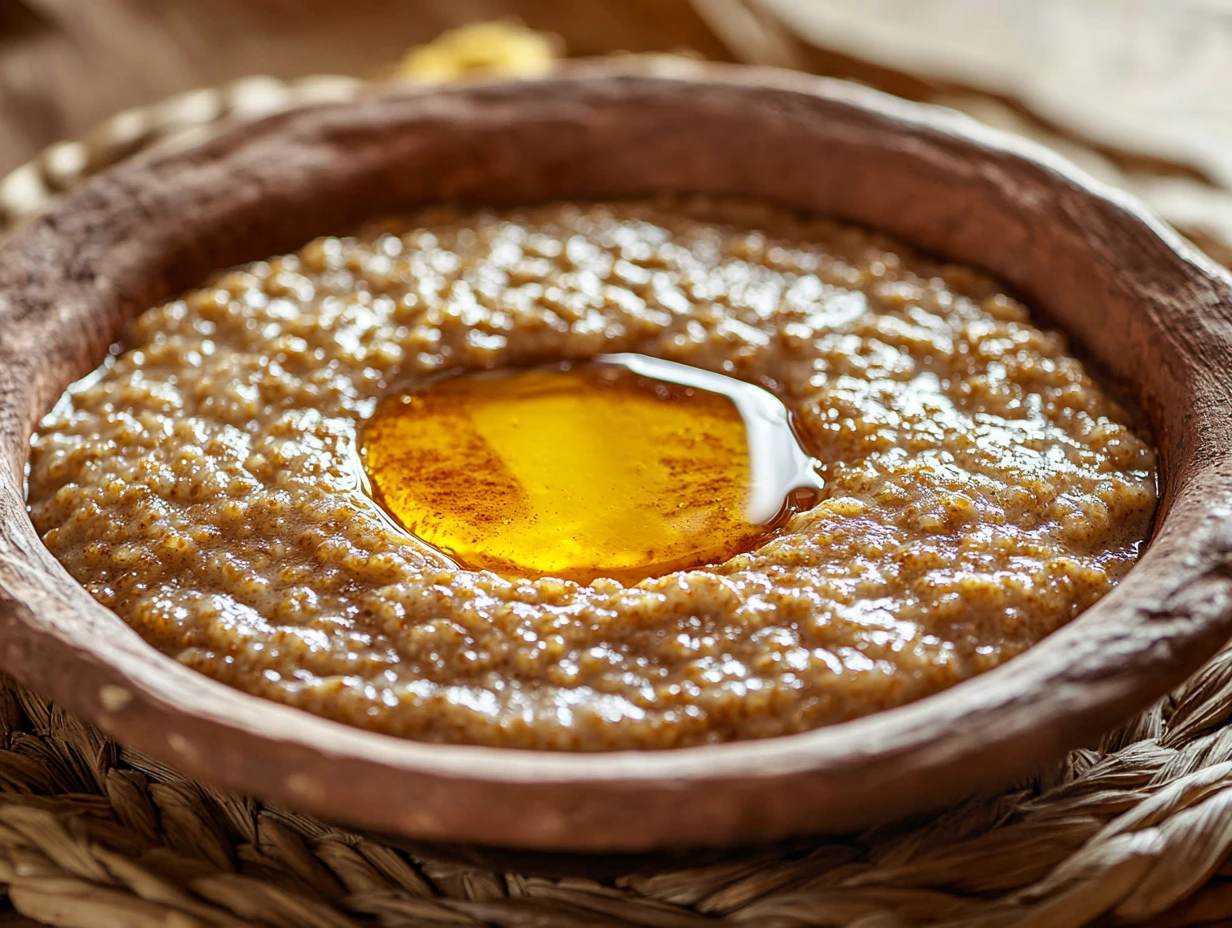
Genfo is a thick Ethiopian barley porridge stirred vigorously until smooth, then served with a well of niter kibbeh; this honey version adds sweetness without losing the dish’s grain-based identity.

10 minsPrep time
20 minsCook time
Serves 4Servings
MediumDifficulty
Genfo with Honey
About this dish

Genfo with Honey: the story on the plate

Genfo is a dense Ethiopian and Eritrean porridge traditionally made from grain flour such as barley or wheat and mixed directly into boiling water until smooth and elastic. It is commonly associated with breakfast and nourishing home food, and the centre is often hollowed to hold spiced butter and chilli; honey can be used as a sweeter variation. The previous coconut-milk, rice-flour and mango version did not reflect the dish. This correction restores roasted barley flour, water and vigorous stirring as the core technique, with niter kibbeh and honey served in the centre.

Historical background

Genfo (also called ga’at in related traditions) is a dense grain porridge associated with Ethiopian and Eritrean home cooking. Barley or wheat flour is commonly worked into boiling water until it forms a smooth, substantial mass.

Why it is famous

Its appeal is the contrast between plain, nourishing grain and a richly seasoned centre. The characteristic well allows each mouthful to pick up spiced butter, chilli or, in this version, honey.

Cultural significance

Genfo is associated with breakfast, nourishment and domestic cooking rather than restaurant-style dessert. Serving it communally from a bowl reinforces its practical, comforting character.


Nutrition

Estimated nutrition per serving

These figures are estimates per serving. Actual nutrition can vary with the brands and exact amounts you use, how much oil, dressing or sauce is absorbed, any substitutions or added extras, and the portion size served.

A practical guide for comparing recipes and planning meals.

310Calories
6gProtein
52gCarbs
10gFat
Ingredients

What you need

  • 320 roasted barley flour, barley flour lightly toasted in a dry pan if roasted flour is unavailable
  • 750 water
  • 1 fine salt
  • 60 niter kibbeh, melted
  • 60 honey, add more at the table if desired
  • 1 berbere, optional; serve separately for a savoury-hot contrast
Method

Step-by-step method

Follow the recipe in order, tasting and adjusting seasoning where needed.

  1. Bring the water and salt to a full boil in a heavy saucepan. Reduce to a strong simmer.
  2. Rain the roasted barley flour into the simmering water with one hand while stirring continuously with the other. Keep stirring until all the flour is incorporated.
  3. Lower the heat and beat the genfo vigorously for 8–10 minutes, turning and pressing the mixture so it cooks evenly and becomes smooth.
  4. Transfer the hot genfo to a wide bowl. Wet the back of a spoon and shape it into a mound, then make a deep well in the centre.
  5. Mix the melted niter kibbeh and honey, then pour into the central well. Serve berbere separately or stir a small pinch into part of the butter for diners who want the traditional hot-savoury contrast.
  6. Serve immediately. Diners can pull pieces of genfo from the edge through the butter-honey centre.
Cook smarter

Tips, storage and serving advice

Shopping tips

Use fresh aromatics and Ethiopian speciality ingredients where they define the dish; substitutions are named in the recipe rather than hidden. Check labels on compound ingredients such as sauces, spice blends, stocks, kimchi, fermented pastes and prepared breads when cooking for allergies.

Ingredient quality

Prioritise fresh ginger and garlic, fragrant spices and correctly labelled Ethiopian pantry ingredients. Measure by weight for repeatable results.

Common mistakes

Using rice flour and coconut milk, adding flour all at once, or stopping the stirring before the raw flour taste has cooked out.

Chef’s tips

Use a heavy pot and a strong wooden spoon. Add flour gradually and beat decisively; texture is built by agitation as much as by time.

How to know it is cooked

The genfo is cohesive, smooth, no longer tastes floury and pulls from the pot in a single thick mass.

Plating advice

Shape into a low mound in a wide bowl and make a deep central well for the butter-honey mixture.

Make ahead

Best made immediately before eating; the dry ingredients can be measured in advance.

Storage and reheating

Refrigerate leftovers for up to 2 days, tightly covered to prevent drying. Reheat slowly with a small splash of water, beating as it warms to restore smoothness.

Wine pairing

What to drink with Genfo with Honey

These are wine-style pairings, so you can choose any bottle in that style rather than needing one exact producer. Look for the grape, region or style name on the label.

Pairings are chosen around the dish’s flavour, texture, richness, acidity and cooking style, not just the country it comes from.

Vin Santo wine pairing
#1 Excellent match Dessert

Vin Santo

Why it works:

Vin Santo complements Genfo with Honey by matching its fruit sweetness while retaining enough acidity to keep the finish fresh and precise.

Tuscan amber dessert wine with dried fruit, nuts and honeyed depth.

GrapeTrebbiano, Malvasia
RegionTuscany
Wine flavourdried apricot, almond, honey, caramel
Serve at10-12°C
  • Flavour bridge: ripe fruit and floral notes mirror the dessert's fruit character
  • Acidity: Bright acidity refreshes after sugar and pastry
  • Body: Light-to-medium richness keeps the fruit in focus
  • Tannin: Low tannin is ideal with sweet fruit
  • Sweetness: Sweetness is calibrated to avoid the wine tasting sour beside dessert
  • Best for: Dinner, entertaining or recipe pairing
View wine guide
Tawny Port wine pairing
#2 Great match Fortified

Tawny Port

Why it works:

Tawny Port complements Genfo with Honey by matching its fruit sweetness while retaining enough acidity to keep the finish fresh and precise.

Sweet fortified wine with caramel, dried fruit, nuts and orange peel. Excellent with sticky toffee, nut desserts, chocolate, caramel and mature cheese.

GrapeTouriga Nacional, Touriga Franca, Tinta Roriz
RegionDouro Valley
Wine flavourcaramel, walnut, fig, orange peel
Serve at12-16°C
  • Flavour bridge: ripe fruit and floral notes mirror the dessert's fruit character
  • Acidity: Bright acidity refreshes after sugar and pastry
  • Body: Light-to-medium richness keeps the fruit in focus
  • Tannin: Low tannin is ideal with sweet fruit
  • Sweetness: Sweetness is calibrated to avoid the wine tasting sour beside dessert
  • Best for: Dinner, entertaining or recipe pairing
View wine guide
Madeira wine pairing
#3 Interesting match Fortified

Madeira

Why it works:

For a more adventurous pairing, madeira complements Genfo with Honey by matching its fruit sweetness while retaining enough acidity to keep the finish fresh and precise.

Long-lived fortified wine with caramel, walnut, citrus peel and roasted notes. Excellent with treacle, toffee, nut cakes and rich savoury sauces.

GrapeSercial, Verdelho, Bual, Malvasia
RegionMadeira
Wine flavourcaramel, walnut, citrus peel, roasted sugar
Serve at12-14°C
  • Flavour bridge: ripe fruit and floral notes mirror the dessert's fruit character
  • Acidity: Bright acidity refreshes after sugar and pastry
  • Body: Light-to-medium richness keeps the fruit in focus
  • Tannin: Low tannin is ideal with sweet fruit
  • Sweetness: Sweetness is calibrated to avoid the wine tasting sour beside dessert
  • Best for: Dinner, entertaining or recipe pairing
View wine guide